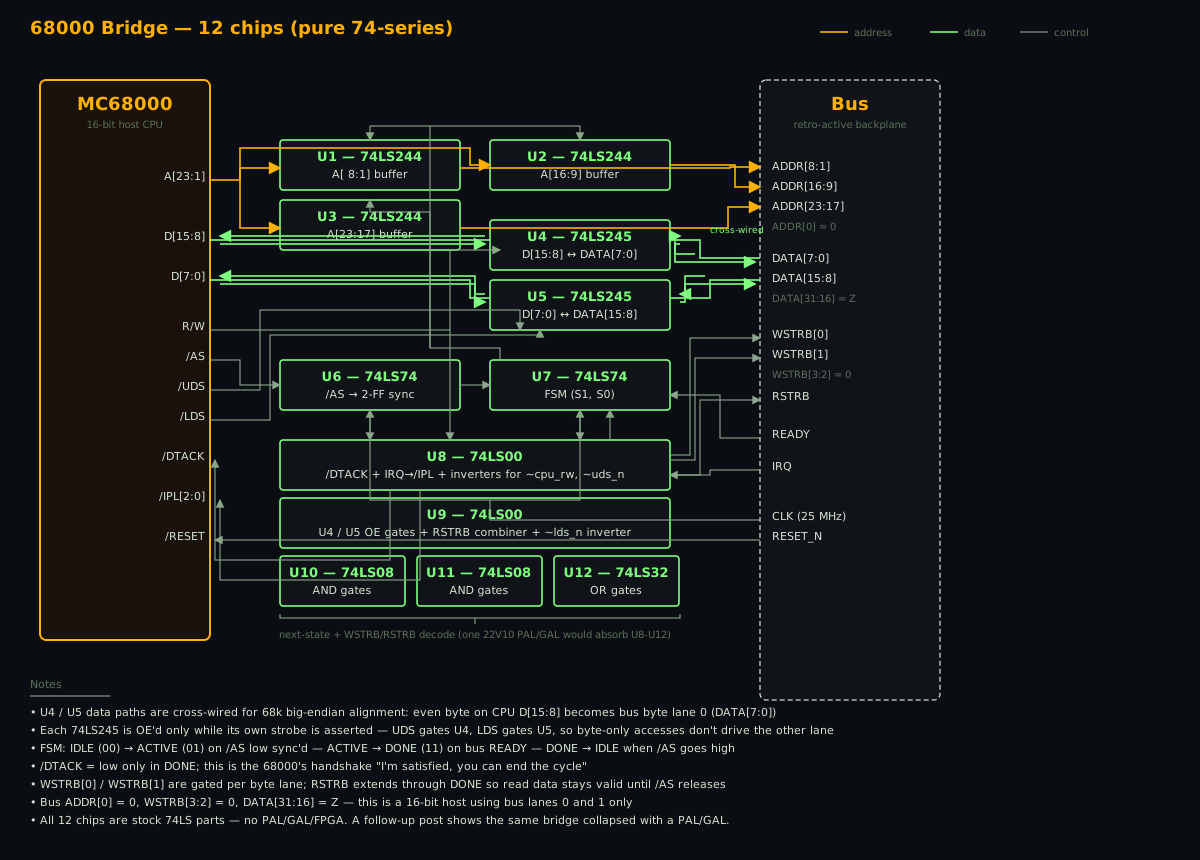
68000 Bridge
A bridge from a 10 MHz Motorola 68000 (asynchronous bus, /AS + /DTACK handshake) onto the Retro-Active common bus, in two flavours: 12 chips of pure 74-series, or 6 chips with a single 22V10 PAL/GAL.
Components
- Motorola MC68000 at 10 MHz (or up to 16.67 MHz with wait-state insertion)
- Pure-74 build: 3× 74LS244, 2× 74LS245, 2× 74LS74, 2× 74LS00, 2× 74LS08, 1× 74LS32
- PAL build: 3× 74LS244, 2× 74LS245, 1× 22V10 (12 → 6 chips)
- Verified in iverilog with a 7-test cocotb suite (6 in PAL build; IRQ defers to interrupt controller)
Links
The 6502 bridge put numbers on the simplest case: 9 chips pure-74, 4 chips with a 22V10. This project does the same for the bigger, richer cousin: the Motorola 68000, running its async bus cycle with /AS, /UDS, /LDS, and /DTACK.
The 68000 is the CPU I always wanted to build around as a kid. It runs free operating systems (EmuTOS, Linux-68k), has a clean instruction set, and sits right in the sweet spot between 8-bit simplicity and 32-bit power. If the bus can’t support a 68k machine in pure 74-series, we don’t really have an ecosystem.
It can. 12 chips pure-74, 6 with a PAL.
The 68000 in a paragraph
Where a 6502 clocks its bus on PHI2, the 68000 does it in an asynchronous handshake:
- CPU drives address on A1-A23 (no A0 pin; byte selection is via the strobes)
- CPU drives R/W
- CPU asserts /AS (Address Strobe) — tells the world “a cycle has started”
- CPU asserts /UDS and/or /LDS — Upper and Lower Data Strobe; which byte lanes are live
- For writes, CPU drives data on D0-D15
- Slave responds by asserting /DTACK (Data Transfer Acknowledge)
- CPU sees /DTACK, samples data (for reads), releases /AS, /UDS, /LDS
- Slave releases /DTACK
No strict clock window, no “sample before PHI2 falls.” The CPU waits for the slave. That’s simpler in one sense — you can’t miss the sample window — and trickier in another: the slave is now contractually obligated to pull /DTACK low to complete the cycle.
The big-endian wrinkle
The 68000 is big-endian, and that surfaces on the bus in a specific way:
- A byte access to an even address uses /UDS, and the data lives on D[15:8] (the “upper” half)
- A byte access to an odd address uses /LDS, and the data lives on D[7:0] (the “lower” half)
- A word access to an even-aligned address uses both strobes, with the byte-at-the-even-address on D[15:8] and the byte-at-the-odd-address on D[7:0]
The Retro-Active bus, meanwhile, is byte-lane indexed by address offset: WSTRB[0] is “the byte at ADDR+0”, WSTRB[1] is “the byte at ADDR+1”, and so on.
Line those up and you get a cross-wire:
   bus DATA[ 7:0]   ↔   68k D[15:8]     (UDS, even byte, WSTRB[0])
   bus DATA[15:8]   ↔   68k D[ 7:0]     (LDS, odd  byte, WSTRB[1])
That cross-wiring is a feature of the bridge, not an accident. It’s the concrete evidence that the bus stays CPU-agnostic: anything that does byte-lane addressing on its own side can line up with the bus’s lane mapping by swapping pins where it crosses the bridge.
The state machine
Because the 68000’s cycle is async, the bridge FSM is actually simpler than the 6502 one:
           /AS low (synced)         bus_ready            /AS high
  IDLE ─────────────────────▶ ACTIVE ───────────▶ DONE ─────────────▶ IDLE
                                (drive bus)    (/DTACK low back to CPU)
Three states, 2 bits. /DTACK is a pure combinational function of state (low in DONE). Once the CPU sees /DTACK, it deasserts /AS, which tells us the cycle is over and we return to IDLE.
Build A — pure 74-series (12 chips)
| Ref | Part | Role |
|---|---|---|
| U1 | 74LS244 | Address buffer A1-A8 → bus ADDR[8:1] |
| U2 | 74LS244 | Address buffer A9-A16 → bus ADDR[16:9] |
| U3 | 74LS244 | Address buffer A17-A23 → bus ADDR[23:17] (7 bits used) |
| U4 | 74LS245 | 68k D[15:8] ↔ bus DATA[7:0] (UDS byte lane, cross-wired) |
| U5 | 74LS245 | 68k D[7:0] ↔ bus DATA[15:8] (LDS byte lane, cross-wired) |
| U6 | 74LS74 | /AS synchroniser (2 FFs into bus_clk domain) |
| U7 | 74LS74 | FSM state (S1, S0) |
| U8 | 74LS00 | Quad NAND: /DTACK + IRQ→IPL inverter + ~cpu_rw, ~uds_n inverters |
| U9 | 74LS00 | Quad NAND: U4/U5 OE gates + RSTRB OR combiner + ~lds_n inverter |
| U10 | 74LS08 | Quad AND: state-machine terms |
| U11 | 74LS08 | Quad AND: strobe terms (in_active·~RW, WSTRB[0], WSTRB[1]) |
| U12 | 74LS32 | Quad OR: next-state OR gates |
12 chips, all stock LS. The five “fat” chips (3 address buffers + 2 data transceivers) are unavoidable. Everything else (U6-U12) is the FSM and combinational glue.
The block diagram
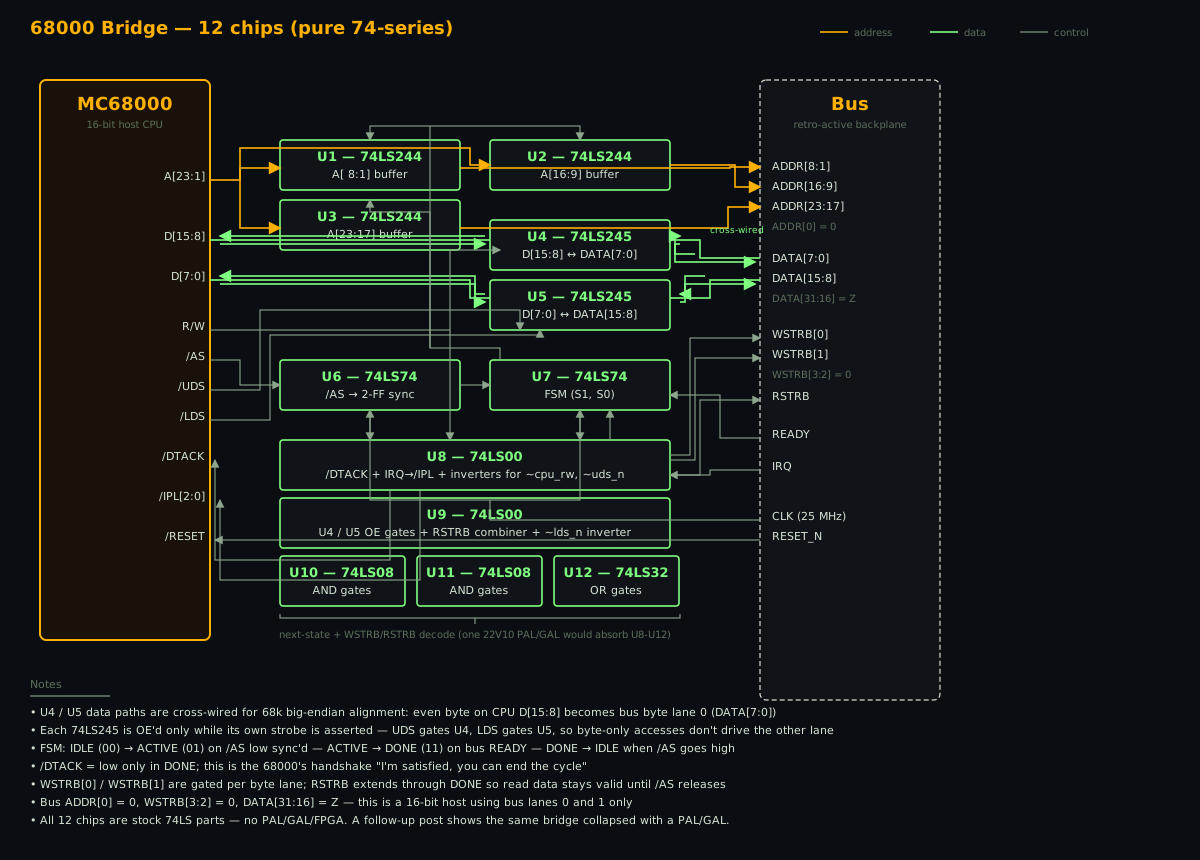
Three families of wires, colour-coded the same way as the 6502 diagram:
- Amber — address. Three 74LS244 banks buffer the 23 address lines onto bus ADDR[23:1]; bus ADDR[0] is tied to 0 (the 68000 has no A0 pin).
- Green — data. Two 74LS245s, cross-wired as described above. Each 245 is OE’d only while its own byte strobe is asserted, so the bridge doesn’t drive a lane the CPU isn’t asking for.
- Grey — control. /AS feeds a 2-FF synchroniser (U6). The FSM (U7) tracks IDLE/ACTIVE/DONE. U8/U9 provide /DTACK, the IPL inverter, and the NAND-based OE/strobe combiners. U10–U12 hold the remaining AND and OR terms.
Build B — with a 22V10 (6 chips)
Same target, single PAL absorbing all the FSM and combinational glue:
| Ref | Part | Role |
|---|---|---|
| U1 | 74LS244 | Address A[8:1] (unchanged) |
| U2 | 74LS244 | Address A[16:9] (unchanged) |
| U3 | 74LS244 | Address A[23:17] (unchanged) |
| U4 | 74LS245 | UDS lane data (unchanged) |
| U5 | 74LS245 | LDS lane data (unchanged) |
| U6 | 22V10 | All FSM + sync + /DTACK + strobes + 245 OEs (absorbs old U6-U12) |
Macrocell allocation (10 of 10 used — exact fit):
| Cell | Type | Function |
|---|---|---|
| M1 | registered | as_n_sync0 |
| M2 | registered | as_n_sync1 |
| M3 | registered | S0 |
| M4 | registered | S1 |
| M5 | combinational | cpu_dtack_n = ~(S1 & S0) |
| M6 | combinational | bus_wstrb_0 = in_active & ~cpu_rw & ~cpu_uds_n |
| M7 | combinational | bus_wstrb_1 = in_active & ~cpu_rw & ~cpu_lds_n |
| M8 | combinational | bus_rstrb = cycle_active & cpu_rw & (~uds_n | ~lds_n) |
| M9 | combinational | u4_oe_n = ~(cycle_active & ~cpu_uds_n) |
| M10 | combinational | u5_oe_n = ~(cycle_active & ~cpu_lds_n) |
Tight — 22V10 is exactly the right size. If you want headroom, a 26V12 (12 macrocells) gives you slack.
Important note on /IPL: in this PAL build the 68000’s /IPL[2:0] interrupt input is generated by the host-side interrupt controller (see the backplane reference), not by the bridge. That separation is what keeps the bridge fitting in one 22V10. If you instead want IRQ inversion in the bridge for parity with the pure-74 build, add one 74LS04 hex inverter — that’s a 7-chip variant.
The collapse: U6-U12 (seven chips) become one 22V10, dropping the chip count from 12 to 6. That’s a 50% reduction.
Test results
Seven cocotb tests exercise the bridge against a 16-bit fake memory target. The PAL build runs the same suite minus test_irq_passthrough (since the PAL bridge has no IRQ pins — that’s the interrupt controller’s job).
[pure-74 build]
test_reset_clean            PASS   360 ns
test_byte_write_read_even   PASS  1050 ns     (UDS,  even-byte path)
test_byte_write_read_odd    PASS  1050 ns     (LDS,  odd-byte  path)
test_word_write_read        PASS  1050 ns     (both strobes together)
test_byte_pair_alignment    PASS  1370 ns     (even+odd writes rejoin as a word)
test_multiple_addresses     PASS  4890 ns
test_irq_passthrough        PASS   700 ns
TESTS=7 PASS=7 FAIL=0

[PAL build]
(same 6 tests above, IRQ test skipped)
TESTS=6 PASS=6 FAIL=0
The byte_pair_alignment test is the one that actually validates the cross-wiring. It writes 0xAB as a byte to address 0x3000 (even, UDS path) and 0xCD to address 0x3001 (odd, LDS path), then reads a 16-bit word at 0x3000. The expected result is 0xABCD — which only happens if the even byte ended up in the CPU’s high half and the odd byte in the low half. It does. The cross-wired 245s carry their weight in both builds.
Multi-slot
The 68000’s full 23-bit address bus passes straight through the bridge to the bus. A 68k system that puts its IO at 0x400000-0x4FFFFF lands automatically on the right slot — ADDR[19:16] selects which one, no extra hardware on the host side.
A separate test build (make TARGET=68k_multislot) exercises the full slot model:
- The 68k PAL bridge talks to a small backplane decoder (one
74LS154+ a 4-bit comparator + a strobe-OR), which generates 16 active-lowSLOT_SEL_nlines fromADDR[19:16] - Two cards are instantiated: card A at slot 3 (
0x430000), card B at slot 7 (0x470000) - The fake targets gate their internal cycle handling on
SLOT_SEL_n
Five tests prove slot isolation:
test_isolation_byte                       PASS  4390 ns   (write to slot 3, slot 7 untouched)
test_isolation_word                       PASS  4390 ns   (word writes; both byte lanes per slot)
test_same_offset_different_slots          PASS  4390 ns   (no card alias on shared offsets)
test_unpopulated_slot_does_not_dtack      PASS  3560 ns   (writes to slot 0 hang waiting for /DTACK)
test_address_outside_io_region_does_not_dtack   PASS  2560 ns
TESTS=5 PASS=5 FAIL=0
The last two are the “negative” tests that prove the backplane decoder is doing its job: a cycle to a slot with no card, or to an address outside the IO region (ADDR[23:20] != 0x4), correctly fails to assert /DTACK and leaves the CPU waiting until it gives up.
Footnote: building the multi-slot test surfaced a real, pre-existing bug in the 68k bridge’s address-buffer wiring (the high
74LS244was double-drivingbus_addr[20]). Single-card tests had been silently masking it — every test address kept that bit zero on both drivers. The multi-slot tests, by hitting0x430000, were the first to set those bits differently. Fix landed alongside the multi-slot work; both pure-74 and PAL builds incorporate it.
What was surprising
After writing the 6502 bridge, I expected the 68000 version to be noticeably harder. It wasn’t, and the reasons are worth calling out:
-
Async beats synchronous. The 6502 bridge had to do edge detection on PHI2, extend its strobes through a DONE state, and hold the 74LS245 open until PHI2 fell. The 68000 version just watches /AS, sets /DTACK, and waits for /AS to release. One signal, three states, done. If I were designing a retro bus from scratch today, I’d pick async handshake over clocked timing — it’s genuinely simpler.
-
Byte-lane decoding is almost free if you cross-wire. The cross-wiring is just PCB traces; the bridge doesn’t even have to think about endianness. It’s done in copper.
-
/IPL fits in the interrupt controller, not the bridge. That’s why the PAL build hits exactly 10 macrocells without spilling. The cleanest split is: bridge handles cycles; interrupt controller handles aggregation.
What’s still open
- Real electrical — zero-delay behavioural sim doesn’t check setup/hold on real LS parts, bus loading, or ground bounce. A bench build needs a scope pass.
- Bus error / abort — the 68000 has a /BERR input for “this slave didn’t answer in time.” Not implemented. A real bridge should raise /BERR if bus_ready never comes.
- FC0-FC2 function codes — ignored. They matter for supervisor/user mode distinction and interrupt acknowledge cycles.
- Read-Modify-Write cycles (TAS instruction) — the 68000 can hold /AS through an RMW. Bridge would need to stay in ACTIVE across multiple bus transactions for this. Not tested.
These don’t change the BOM. They’re incremental features.
The two bridges side by side
| 6502 bridge | 68000 bridge | |
|---|---|---|
| Pure 74-series chip count | 9 | 12 |
| With one 22V10 PAL/GAL | 4 | 6 |
| CPU data width | 8 bit | 16 bit (two 8-bit lanes) |
| CPU address width | 16 bit | 23 bit |
| Bus cycle style | synchronous (PHI2) | asynchronous (/AS + /DTACK) |
| FSM states | 4 (IDLE/DRIVE/WAIT/DONE) | 3 (IDLE/ACTIVE/DONE) |
| Trickiest bit | data hold through DONE | byte-lane cross-wiring |
| Single-card tests | 5 PASS | 7 / 6 PASS (pure-74 / PAL) |
| Multi-card tests | 3 PASS (slot 0 + quiet card at slot 5) | 5 PASS (cards at slots 3 and 7) |
Both bridges fit comfortably in what any hobbyist would call “a handful of chips,” whether or not you allow programmable logic.
Try it yourself
The full design lives in the repository under bus-design/:
cd bus-design/test
source ../../.venv/bin/activate
make TARGET=68k              # 12-chip pure-74 build, single card
make TARGET=68k_pal          # 6-chip PAL/GAL build, single card
make TARGET=68k_multislot    # PAL build + backplane + 2 cards at slots 3 & 7
If you’re a Z80 or 8088 builder, your bridge is probably somewhere between these two. If you’ve built one, or are thinking about building one: tell us what broke.