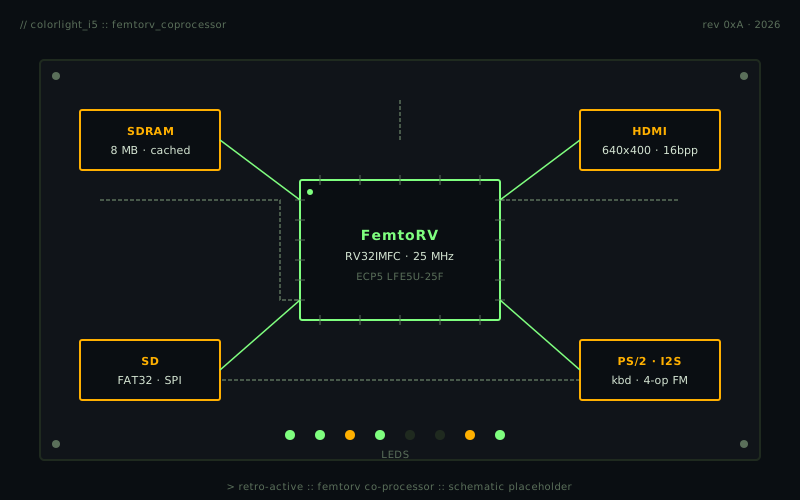
FemtoRV Retro Co-Processor
A RISC-V co-processor for vintage computers — HDMI GPU, PS/2 keyboard, FM synth, SD card, all on a $15 FPGA.
Components
- Colorlight i5 (ECP5 LFE5U-25F)
- FemtoRV petitbateau (RV32IMFC core)
- 8 MB SDRAM (EM638325) with write-through cache
- HDMI tri-mode GPU (text, bitmap, 640×400×16bpp framebuffer)
- 4-voice 4-operator FM synthesizer + 48 kHz PCM mixer
- PS/2 keyboard controller with interrupt-driven scan decoder
- SD card over SPI, FAT32 read
- Custom 32-source edge-triggered interrupt controller
Links
What it is
The FemtoRV Retro Co-Processor is a working demonstration of the Retro-Active pattern: a small, updatable RISC-V core that lives next to a vintage CPU and hands it all the peripherals a modern user expects — HDMI output, PS/2 keyboard input, SD-card mass storage, and audio synthesis — on a commodity FPGA board that costs about the price of a restaurant lunch.
The core is Bruno Levy’s FemtoRV petitbateau, the RV32IMFC variant of the FemtoRV family, running at 25 MHz on the ECP5-based Colorlight i5. It is small enough to live comfortably beside a 6502, 68000, or Z80, and open-source enough that every peripheral, every driver, and every bitstream can be rebuilt from scratch with Yosys, nextpnr, and a RISC-V GCC.
Why co-process?
Vintage CPUs are charming, but their I/O is a liability. A real 6502 has no way to speak HDMI. A real Z80 can’t read a FAT32 SD card without a heroic driver stack. Every modern peripheral a retro builder wants to add ends up eating a card slot and a weekend of timing analysis.
The co-processor moves that work to a chip that’s built for it. The host
CPU talks to a simple memory-mapped interface; FemtoRV takes care of the
rest — scan-code decoding, scanline generation, FM synthesis, filesystem
parsing. Firmware updates are a make && openFPGALoader, not a board
respin.
Numbers
| Metric | Value |
|---|---|
| CPU performance | 4.7 MIPS, 4.38 DMIPS (Dhrystone 2.1) |
| FPU performance | 952 KFLOPS |
| Memory bandwidth | 3 MB/sec (memcpy, 64 KB block) |
| DMIPS/MHz | 0.175 |
| LUT usage | 57 % (13,937 / 24,288) |
| Block RAM | 71 % (40 / 56) |
| Timing margin | Max 32.6 MHz — 30 % slack at 25 MHz |
That headroom matters: it means every peripheral listed below is running concurrently, and the core still has cycles to spare for the host interface.
What it can do today
- Boot from SD card into a RetroKernel shell (Unix-style
ls,cat,cp,rm,mkdir, and a program loader with XMODEM upload) - Render an 80-column, 16-color text console to HDMI at 640×400
- Display RGB565 framebuffers pulled from SDRAM via a burst scanline fetch engine and ping-pong line buffer
- Play 4-voice 4-operator FM synthesis mixed with 48 kHz PCM samples over I²S or a PWM DAC
- Decode PS/2 scan codes into ASCII with modifier tracking, via a 32-source edge-triggered interrupt controller
- Execute cached reads from 8 MB of external SDRAM with zero stall on hit, served by a 64-entry direct-mapped write-through cache
Everything above has cocotb testbenches in FemtoRV/TEST/ and has been
verified on hardware.
The vision
This project is the proof of concept for the wider Retro-Active idea: if the community agrees on a common bus and a common peripheral interface, one well-engineered co-processor can ride along with a 6502 SBC, an FPGA-recreated Amiga, or a restored vintage workstation. The same SD driver, the same font ROM, the same FM voice presets all come along for free.
What’s next
The near-term roadmap: a VT100/ANSI terminal mode on the GPU, LFO and operator feedback for the synth, a 2-way set-associative SDRAM cache, and — most importantly — a physical retro bus interface so the co-processor can drop into a real vintage card cage instead of sitting on a bench next to one.
Source, schematics, and build instructions are all on GitHub. Patches and pull requests very welcome.