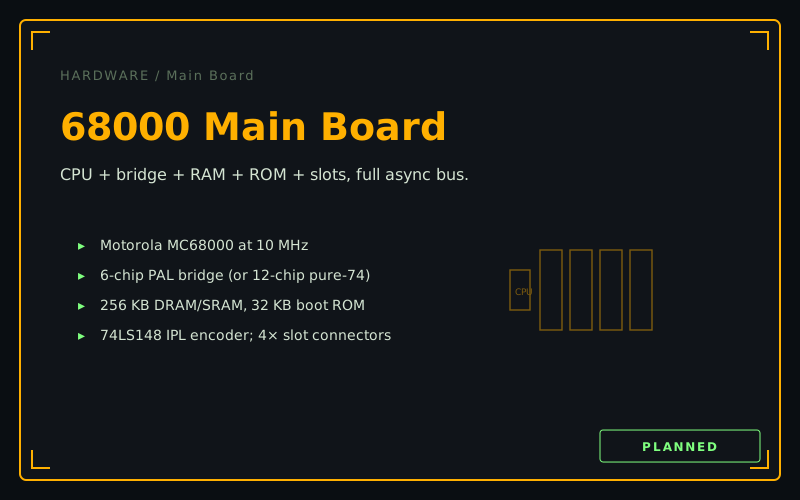
68000 Reference Main Board
A finished 68000-based main board: CPU, the 68k bus bridge, RAM, ROM, IPL priority encoder, and four backplane connectors. The starter board for a 16-bit Retro-Active build.
Components
- Motorola MC68000P10 (10 MHz DIP) or MC68000FN16
- Retro-Active 68k bridge (PAL build, 6 chips, or pure-74 build, 12 chips)
- 32 KB boot ROM (parallel, 8-bit or 16-bit wide)
- 256 KB DRAM or SRAM (16-bit wide)
- Slot interrupt path: 2× 74LS148 priority encoders → /IPL[2:0]
- 4 × DIN 41612 96-pin backplane connectors
Links
The 16-bit counterpart to the 6502 main board. Same shape — CPU + bridge + RAM + ROM + slots — but with the 68000’s wider data path, full 24-bit address bus, and asynchronous /AS+/DTACK handshake.
Status: planned (design phase).
What’s on the board
- CPU — a real Motorola MC68000 in a 64-pin DIP socket. The 10 MHz P-grade is the easy choice; the 12.5 MHz or 16 MHz parts work too if the rest of the timing budget allows.
- The bridge — the 6-chip PAL build. The 68k’s full 23-bit address bus passes through the bridge to the bus, so a 68k system that puts its IO at
0x400000-0x4FFFFFlands cleanly on the right slots without any extra glue. - ROM — 32 KB minimum; 64 KB if you want a real monitor + a small BASIC. Maps high (0xFE0000–0xFFFFFF) so the 68k’s reset vectors at 0x000000–0x000007 can come from ROM at boot, then RAM after the boot copies vectors down.
- RAM — 256 KB is comfortable for a 68k system; less is possible. 16-bit-wide SRAM (or DRAM with a refresh controller) sits in the low end of the address space.
- IPL priority encoder — two cascaded 74LS148s convert the 16 per-slot
IRQ_nlines into the 68k’s 3-bit/IPL[2:0]priority code. No microkernel-side aggregation register needed; the 68k’s interrupt vector handles steering. - Backplane — same 4-slot DIN 41612 connector setup as the 6502 board.
Why the 68k case is “easier” software-wise
A 68k system has 16 MB of address space, so it can map the full bus directly and keep its local RAM/ROM at low addresses. There’s no equivalent of the 6502’s “which slot do I see?” problem — every slot is reachable from any 68k address in the IO region.
That makes the 68k a better target for the multi-user OS variant. With 256 KB of RAM and a full 24-bit address space, you can run a small kernel + multiple user processes + a file system without straining the address map. Adding an external MMU (a 74-series-friendly 4×4 KB page table chip, or one of the 68000-era memory mapping IC families) gives you proper process isolation.
Open design questions
- DRAM vs SRAM — DRAM is cheaper per bit but needs a refresh controller (~3 chips of glue or one PAL). SRAM is plug-and-play but more expensive. Probably DRAM for the v1 board to keep the BOM honest about a “real” 68k system.
- Bus error / abort — the 68k has a /BERR input the bridge currently ignores. The board needs a watchdog: if a card cycle takes longer than ~10 µs without /DTACK, raise /BERR so the CPU can recover.
- Function code (FC0–FC2) — supervisor vs. user mode. Plumbed for future use? Or ignored for v1?
- DTACK pull-up — the /DTACK line on the slot connector needs a pull-up (cards drive it active-low when responding). Where does that resistor live?
Dependencies
This board cannot be built before the 68k bridge runs on real hardware (currently sim-only, like the 6502 bridge), and a DRAM refresh controller design exists if we go that route. It does not depend on any peripheral card existing.
Next steps
- Pick DRAM or SRAM.
- Schematic in KiCad.
- Bring up the bridge on a breadboard against a real 68000.
- PCB layout, fabrication, first article.
- Open BOM and Gerbers.
Contributions wanted: 68000 hardware reviewer, KiCad library curator, anyone who’s done a 68k DRAM refresh circuit before.