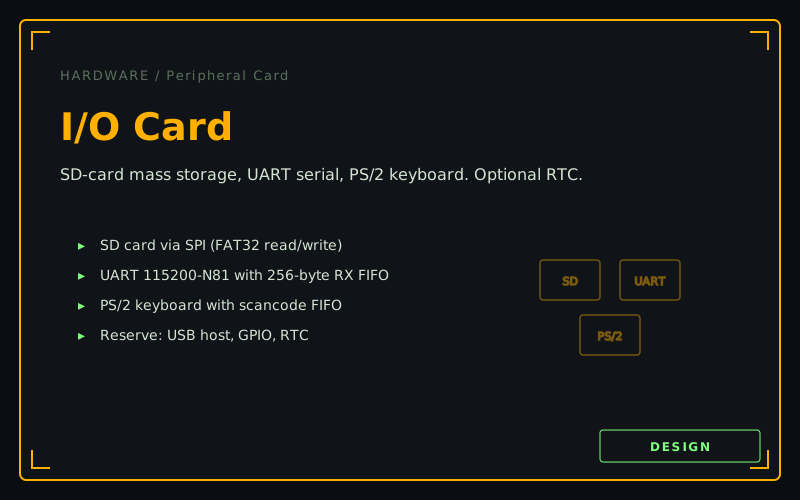
I/O Card
Reference I/O peripheral: SD card mass storage (FAT32), UART serial, and PS/2 keyboard. The 'console + storage' card for any Retro-Active build.
Components
- SD card socket (microSD or full-size)
- UART transceiver (MAX3232 for RS-232 levels) + DB9 or 6-pin Dupont
- PS/2 mini-DIN connector + line clamp
- Either: a small FPGA (ICE40 LP1K) for all three, OR a 65C51 / 16550 UART + bit-bang SD + PS/2 controller IC
- Optional: RTC chip (DS3231 over I²C) on a header
- Reserve pins / bus space for future USB host
Links
The third “always need one” peripheral after video and audio: an I/O card that gives the system mass storage, a serial console, and a keyboard.
Status: design phase.
What’s on the card
SD card slot
The mass-storage path. SPI-mode SD card is the simplest option: four signals (CLK, MOSI, MISO, /CS) plus power, FAT32 filesystem, no driver-side wear-leveling needed because that’s the card’s job. Bit-banged from the bus is possible but slow (~30 KB/s on a 1 MHz 6502). A small FPGA on the card, or a dedicated SPI master, gets you 1–3 MB/s.
UART serial
The serial console. 115200-N81 is the canonical baud. Two implementation options:
- Discrete-friendly: 65C51 or 16550 UART chip + MAX3232 level shifter. Both still in production. Three or four chips total.
- FPGA-friendly: a soft UART core in the same FPGA that does SD + PS/2.
Either way the board exposes a DB9 or 6-pin Dupont header.
PS/2 keyboard
Standard 6-pin mini-DIN. PS/2 is a synchronous serial protocol with a clock the keyboard generates; the card needs an edge-triggered shift register and a small FIFO of decoded scan codes for the host to pull from. Either soft (FPGA) or hard (a dedicated PS/2 controller IC like the AT89C51 — though those are scarce now).
The existing FemtoRV PS/2 controller has all this logic implemented and tested; re-packaging it as a card is mostly hookup work.
Optional extras
- RTC — DS3231 via I²C on a header. Tiny, cheap, fixes timestamps.
- GPIO — a 4× or 8× open-drain header for builders to wire whatever they want.
- USB host — reserved pins on the slot connector and reserved space in the register window. Not v1.
Bus interface
Slot’s 64 KB window divides three ways:
| Range | Purpose |
|---|---|
+0x0000 – +0x00FF | Card identification, status, IRQ enable mask |
+0x0100 – +0x01FF | UART control + 256-byte RX FIFO read window |
+0x0200 – +0x02FF | PS/2 status + scan-code FIFO read window |
+0x0300 – +0x03FF | SD card command / status / data sliding window |
+0x0400 – +0xFFFF | Reserved (RTC mailbox, GPIO, future USB) |
Each subsystem can fire IRQ_n on its own conditions: UART RX-not-empty, PS/2 byte available, SD-DMA-complete. The host’s interrupt controller distinguishes which slot fired, then this card’s driver code reads its own status register to learn which subsystem fired.
Dependencies
- Bus standard (done)
- A main board to plug into
- An I/O driver stack in the driver library — three drivers really: SD/FAT32, UART, PS/2
Next steps
- Decide: one FPGA or three discrete chips? The right answer is “ship both options” but v1 picks one. The FPGA option is faster to prototype.
- Re-package the FemtoRV SD + PS/2 + UART blocks.
- Card layout — connector-heavy, so this is the largest card mechanically.
- Document the register map.
Contributions wanted: anyone who’s done FAT32 on a tight budget (driver code reuse), reviewers familiar with PS/2 timing edge cases (key release vs. key make handling).