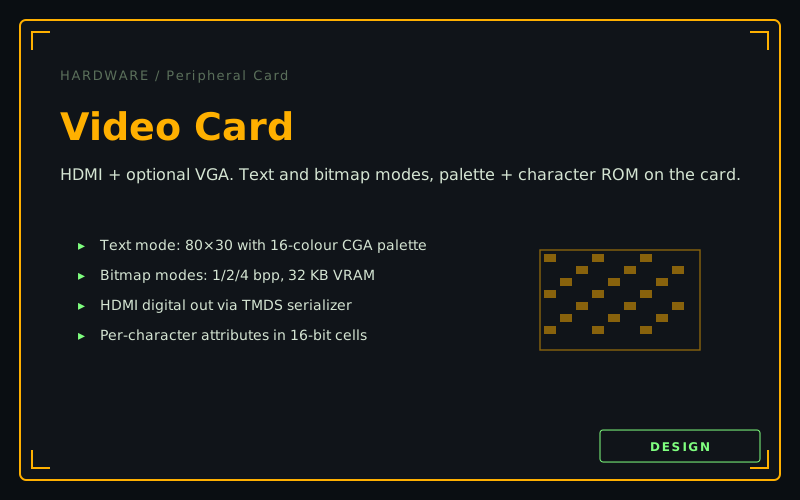
Video Card
Reference video peripheral: HDMI digital output (and optional VGA), text and bitmap modes, character ROM and palette on the card. Drops into any Retro-Active backplane slot.
Components
- Small FPGA (ICE40 LP1K-class, ~1k LUT) for TMDS encoding and scanout
- 32 KB VRAM (1× SRAM)
- Character ROM (8×16 VGA-style font, 4 KB)
- 16-entry RGB444 palette register file
- HDMI connector + level shifters
- Optional: passive RGB+sync header for VGA
Links
A reference video card for the Retro-Active backplane. Drops into any slot, presents itself as a video device, drives an HDMI display.
Status: design phase — much of the underlying GPU design already exists in the FemtoRV co-processor and just needs to be re-packaged as a slot card with bus-protocol wrapping.
Modes
Three display modes the card supports out of the box:
- Text mode — 80×30 characters, 16-bit cells:
{bg[3:0], fg[3:0], char[7:0]}. CGA-style 4-bit IRGB palette per cell. Character ROM holds an 8×16 VGA font; palette is 16 RGB444 entries software-programmable. - Bitmap mode — 1, 2, or 4 bits per pixel into a 32 KB VRAM, paged for double-buffering. 4 bpp gives a 320×200 indexed image with the card’s 16-entry palette.
- Framebuffer mode — 16 bpp RGB565 from external memory (read directly from the host’s RAM, typically over the bus via a burst-read mechanism the bus supports).
Why an FPGA on the card
Pure 74-series HDMI is impractical — TMDS encoding plus the 250 MHz serial clock for 720p needs gate-level structures that don’t exist in standard logic families. A small ICE40 LP1K gives you the encoder, the line-buffer, and the scanout state machine in ~700 LUTs.
This is a place where the bus standard’s “implementation neutral” stance gets tested: a builder who won’t use programmable logic anywhere can still build a video card, but they’re looking at a CRTC chip (Motorola MC6845) plus discrete RGB DAC and a VGA connector — no HDMI. We’ll publish both options. The FPGA path is the canonical reference; the 74-only path gets its own follow-up.
Bus interface
The card lives in one slot’s 64 KB register window. Within that window:
| Range | Purpose |
|---|---|
+0x0000 – +0x000F | Mode + control registers |
+0x0010 – +0x002F | Palette (16 × 16-bit RGB444 + 4 reserved) |
+0x0030 – +0x00FF | Reserved / future |
+0x1000 – +0x4FFF | Character buffer (16 KB, text mode) |
+0x4000 – +0xBFFF | Bitmap VRAM (32 KB, bitmap mode) |
+0xC000 – +0xFFFF | Status / vsync / hpos read-back |
Writes go through WSTRB[0..1] (the card uses both byte lanes); reads return the corresponding bytes via RSTRB. VBlank fires the card’s IRQ_n on the slot connector.
Dependencies
- Bus standard (done — slot register window is 64 KB, byte-lane addressing settled)
- A main board to plug the card into (6502 or 68000)
- A video driver in the driver library so software can use the card without poking registers directly
Next steps
- Pull the FemtoRV GPU RTL into a card-shaped module with the bus interface as its only external port.
- Validate it in cocotb against the multi-slot test harness.
- PCB layout for the smallest practical card.
- Document the register map as a public spec.
Contributions wanted: reviewers who’ve done HDMI on small FPGAs, anyone with strong opinions on where text-mode attribute bits should live.