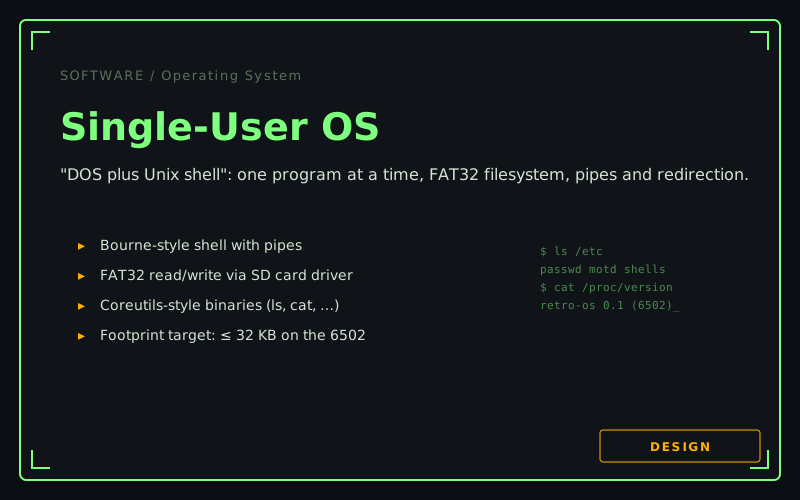
Single-User OS
DOS sensibilities, Unix CLI. One program at a time, FAT32 filesystem, a Bourne-style shell with pipes and redirection. Targets the 6502 and other tight machines.
Components
- Built on the Retro-Active microkernel
- Bourne-style shell (sh) with pipes and redirection
- Coreutils-style binaries (ls, cat, cp, rm, mkdir, …)
- FAT32 filesystem service
- Footprint goal: ≤ 32 KB on 6502
Links
The default OS personality for tight machines: a 6502 running 32 KB of RAM, a Z80 with a similar budget, anything that wants the simplicity of “one program runs at a time, you talk to it through a shell.” DOS sensibilities — boot to a prompt, run things, type dir and look at files. Unix CLI — pipes, redirection, lowercase commands, slash-separated paths.
Status: design phase, building on the existing RetroKernel work in the FemtoRV co-processor.
What it feels like
boot v0.1
loaded /kernel.bin (28760 bytes)
loaded /init (1240 bytes)

retro-os 0.1 (6502)
$ ls /etc
passwd  motd  shells
$ cat /etc/motd
welcome to retro-os, this thing is small but it works
$ cat /etc/motd | wc -l
1
$ ./editor /tmp/notes.txt
... (editor runs)
$ help
builtins:  cd  exit  set  unset  alias  history
$
That’s the target. Boot to a prompt in under a second on a 6502 at 1 MHz. Pipes work. Redirection works. The shell is small enough to live in RAM with the running program; the program returns and the shell comes back.
What’s not here
Deliberately omitted to keep the budget honest:
- No multitasking. The shell runs, then it forks-and-execs a child, the child runs to completion, the shell comes back. Standard DOS / CP/M idiom.
- No multiple users. Anyone at the console is the user.
- No memory protection on machines that lack an MMU. A buggy program can corrupt the kernel. Programs are trusted.
- No networking in v1. A network stack is a multi-user-OS concern.
Builders who want any of those things should look at the multi-user OS variant.
Architecture
The single-user OS is itself a small set of services running on the microkernel:
                ┌──────────────────┐
                │  user program    │  (one at a time)
                └────────┬─────────┘
                         │ syscalls (over IPC)
                ┌────────┴─────────┐
                │  shell (sh)      │
                └────────┬─────────┘
                         │
   ┌─────────────────────┼──────────────────────┐
   │                     │                      │
┌──┴──┐              ┌───┴────┐            ┌────┴────┐
│ FS  │              │ Console│            │ Drivers │
│(FAT)│              │ (UART) │            │ (kernel)│
└──┬──┘              └────────┘            └─────────┘
   │
┌──┴──┐
│ SD  │
│ drv │
└─────┘

           ─── microkernel ───
Six or so services in total. Each is a thread in the kernel’s view. Each is small (a few hundred lines of C).
Footprint
Goal: ≤ 32 KB total on a 6502 system, including the kernel.
| Component | Target |
|---|---|
| Kernel | ≤ 6 KB |
| FS service | ≤ 4 KB |
| Console service (UART) | ≤ 1 KB |
| Driver shims (SD, video, audio) | ≤ 4 KB |
| Shell | ≤ 8 KB |
| Coreutils binaries (avg) | ≤ 1 KB each, on demand |
Coreutils are loaded from disk on demand, not kept in RAM. That’s the only way the budget closes — ls lives on the SD card, runs, terminates, and its memory is reclaimed.
The 68k version is much more comfortable: same OS personality, but with hundreds of KB to spare. That’s where you’d run an editor, a compiler, or a port of vim-style tooling.
Filesystem
FAT32 read+write. Same disk format as everything else in 2026: a card written on a Mac or Linux box plugs into the SD slot and shows up. No proprietary on-disk format, no migration headache.
Path conventions are Unix-style: /, lowercase, no drive letters. The boot device mounts at /. Any second SD card or virtual disk mounts under /mnt/... like a sensible system.
Shell
Bourne-style. The shell parser is small but real:
- Pipes:
cmd1 | cmd2 | cmd3 - Redirection:
cmd > file,cmd < file,cmd >> file - Background:
cmd &(works only on machines that can multitask — pretends on the 6502) - Variables:
set FOO=bar,$FOOexpansion - History: arrow keys recall previous commands
Builtins are minimal: cd, exit, set, unset, alias, history. Everything else is a binary on disk.
Dependencies
- The microkernel must work
- An I/O card for SD storage and the console UART
- The driver library populated with at least SD/FAT32, UART, and one of {keyboard, display}
- A bootloader that can load the kernel + init image
Next steps
- Define the syscall set (
open,read,write,close,exec,exit,dup,pipe). - Port the existing RetroKernel shell to the new microkernel’s IPC.
- Write the FS service as a separate thread (currently inlined in RetroKernel).
- First-light on a 68k system; then squeeze it onto a 6502.
Contributions wanted: shell implementers, anyone who’s run a small Unix-alike before, FAT32 specialists, anyone with strong opinions about the syscall surface.